In Spring of 2003, an ECOMOG peacekeeping mission composed of S’Leonian troops landed at Roberts International Airfield; the task of demilitarizing ex-combatants was among their chief priorities. Street fighting in Monrovia had subsided over the past few months, and many citizens felt that Liberia, in fact, was demilitarized.
“That is what surprised so many people,” a friend of mine recounted, as we sat at a beach in Sincor, Monrovia.
“People thought the war was over, until ECOMOG and UNMIL troops began offering money for remaining weapons. One of the largest collection points was on Randall Street at Stop and Shop [one of three major grocery stores in downtown Monrovia]. Troops offered up to 100 dollars (USD) for a rifle, and 50 dollars for three shots… I remember standing on the street and watching children and old ladies come with reels of ammunition.
“This did not have the desired effect, however, because during the war, Taylor and his opponents armed their soldiers. People were given weapons to go to the front lines – so even those who already owned arms received guns. Many people had two or three AK 47s.
“The system of purchasing weapons was also just dangerous. One time, UNMIL ran out of money and had to tell a crowd of people bearing guns and ammunition that they would not receive the money they expected.”
The demilitarization of Liberia, according to many, is a job left undone. Particularly in the outer counties, communities possess stockpiles of weapons; further still, many Monrovians believe they would require little persuasion to put them to use. Ex-combatants, and armed civilians for that matter, are know to have sunk weapons in nearby using sealed containers filled with oil; the lakes make ideal hiding grounds and the oil lubricates the guns and artillery such that they may be surfaced and used years later.
What would be the most effective way to route a county of such weapons? Today, UN peacekeeping missions continue to offer money for arms in southern Sudan (among other places, I would imagine). Money for guns is standard operating procedure. Though clearly this process was not fully successful in Liberia, the practice is still used and the implementers are still thought to be vital to the peace in Liberia.
“UNMIL cannot pull out of Liberia yet. Though we all agree they cannot be permanent, they must stay until people have faith in the new army [the Armed Forces of Liberia]. For now, it’s just too soon.”
Wednesday, January 16, 2008

Thursday, January 10, 2008
Strangers At the Door
American Airlines neglected to get one of my suitcases (incidentally, the one with the electronics I was carrying for our office) onto my flight departing Boston; I realized this at Heathrow’s baggage claim, when I was racing to get to Gatwick for my flight to Monrovia. Luckily for me, AA connected my suitcase to an SN Brussels flight. That flight arrived today - and after a speedy unpacking job, I confirmed that everything arrived.
I was at my apartment early this afternoon to finish this task and decided to show our landlord a broken screen in one of our windows while I was home. Mohammed inspected the window and said he would send someone up to fix it later.
I quickly made lunch, and no sooner had I sat down than I heard someone knock on the door, then saw a face peering through the window. Assuming this was the man to fix my window, I unlocked the door … and found no one. I walked onto the porch in time to see a man leaving the compound – the garage door was open, unattended of course.
This is at least the third time that I’ve been home, midday (previous times were Sundays), and someone has knocked and disappeared. Based on my apartment’s earlier experience with someone finding the door open, and subsequently cleaning out a purse sitting in a living room, I can only imagine that people have success with just trying to open various doors.
I was at my apartment early this afternoon to finish this task and decided to show our landlord a broken screen in one of our windows while I was home. Mohammed inspected the window and said he would send someone up to fix it later.
I quickly made lunch, and no sooner had I sat down than I heard someone knock on the door, then saw a face peering through the window. Assuming this was the man to fix my window, I unlocked the door … and found no one. I walked onto the porch in time to see a man leaving the compound – the garage door was open, unattended of course.
This is at least the third time that I’ve been home, midday (previous times were Sundays), and someone has knocked and disappeared. Based on my apartment’s earlier experience with someone finding the door open, and subsequently cleaning out a purse sitting in a living room, I can only imagine that people have success with just trying to open various doors.
2008 in Liberia
For a NH native so engrossed by American politics it takes quite a bit of motivation to leave the state two days before US primary elections. But, on Sunday evening, I pulled myself away from campaign-hysteria and slid down to Logan International to catch a flight back to Monrovia – hoping to find the unpredictable, ever-entertaining scene I’d left on Dec 17th.
Monrovia did not disappoint. In fact, random, bizarre hilarity began with the flight we took to Monrovia. As Gatwick’s moving sidewalk accelerated my walk towards the departure gate, my peripheral vision caught the glimpse of a Nordic-looking figure on the tail of a plane. At a full stare, the plane read “Iron Maiden: the 2008 Tour”. Check it out:

Of course, this was our plane from Gatwick to Monrovia. Iron Maiden, we learned, was going on tour the following month (not in Liberia, incidentally). The lead singer, furthermore, is a certified pilot. Who knows.
We landed on time – in stark contrast to our flight departing Monrovia, which was 7 hours late. We stalled on the runway for about 15 minutes, before the flight attendants informed us that the rolling staircase was not attaching to the plane, and we should subsequently mind the gap.
Heeding the stewardess's warning, I stepped onto the platform (the “gap” couldn’t have been six inches wide) to the immediate stench of burning rubber. I hadn’t forgotten how heavily the air in Liberia sits in the lungs, but I wasn’t really prepared for the smell. Quite honestly, I didn’t recognize the new odor; my roommate identified it later that evening.
I’d had a long vacation – but Monrovia appeared to have made more progress that I’d expected. Blocks and blocks of Tubman Boulevard had been repaved and dumpsters had been distributed throughout the city. Where piles of rubbish used to steam, there now sat enormous, yellow dumpsters. I was thrilled to see (and smell) this improvement. Every morning I jog by a pile of trash, which at least, now is elevated above nose level.
Ironically enough, while jogging this morning I noticed two teenage girls emptying the trash. It looked like they were sorting – for what, exactly, I’m unsure. It was early morning, though, so they’d have all day to sell their findings. The image seemed to capture both that Liberia the speed at which Liberia is changing and raise the question as how the changes will effect the lives of average citizens.
Monrovia did not disappoint. In fact, random, bizarre hilarity began with the flight we took to Monrovia. As Gatwick’s moving sidewalk accelerated my walk towards the departure gate, my peripheral vision caught the glimpse of a Nordic-looking figure on the tail of a plane. At a full stare, the plane read “Iron Maiden: the 2008 Tour”. Check it out:

Of course, this was our plane from Gatwick to Monrovia. Iron Maiden, we learned, was going on tour the following month (not in Liberia, incidentally). The lead singer, furthermore, is a certified pilot. Who knows.
We landed on time – in stark contrast to our flight departing Monrovia, which was 7 hours late. We stalled on the runway for about 15 minutes, before the flight attendants informed us that the rolling staircase was not attaching to the plane, and we should subsequently mind the gap.
Heeding the stewardess's warning, I stepped onto the platform (the “gap” couldn’t have been six inches wide) to the immediate stench of burning rubber. I hadn’t forgotten how heavily the air in Liberia sits in the lungs, but I wasn’t really prepared for the smell. Quite honestly, I didn’t recognize the new odor; my roommate identified it later that evening.
I’d had a long vacation – but Monrovia appeared to have made more progress that I’d expected. Blocks and blocks of Tubman Boulevard had been repaved and dumpsters had been distributed throughout the city. Where piles of rubbish used to steam, there now sat enormous, yellow dumpsters. I was thrilled to see (and smell) this improvement. Every morning I jog by a pile of trash, which at least, now is elevated above nose level.
Ironically enough, while jogging this morning I noticed two teenage girls emptying the trash. It looked like they were sorting – for what, exactly, I’m unsure. It was early morning, though, so they’d have all day to sell their findings. The image seemed to capture both that Liberia the speed at which Liberia is changing and raise the question as how the changes will effect the lives of average citizens.
Monday, November 26, 2007
Susu
Susu is a traditional form of banking in Liberia. The goal is financial management, and the investors act more as a support staff than as investors. That is to say, money changes hand, but no profit is generated. The benefit, still, is huge. Just ask Jonathon.
Jonathon is a self-made business man. Just three years ago, he took a loan from a Lebanese man to buy a car. At the time he had neither prospective clients, nor the expectation that he would be able to pay his loan any time soon.
Today Jonathon is the sole proprietor of Jonathon’s Internet Café. His facility dons three computers with high speed internet (high speed, as in 128 kbps … enough to make a skype call) and a Vonage phone (a phone with a US number to that allows callers to pay US long distance rather than international roaming fees).
Equally impressive, is the booming taxi business Jonathon has built for himself. He is one of only a handful of drivers whom internationals call for transportation throughout Monrovia. His reputation has grown through word of mouth – as has his social capital. His clients routinely send him to the Roberts International Airport (RIA) where he is often the first face that new arrivals to Liberia meet.
Though Jonathon’s story is a success by any “up from your boot-straps” standard, he is faced with a challenge. Word of mouth and client-by-client growth is important, but how can he elevate his business to the next level? Taking a loan from a local bank is ill-advised; even keeping money in a bank account is considered risky (most people have a safe at home, or an alternate storage system).
This is where Susu plays a turn.
The “susu” is a group of like-minded business folk (men, most often) who enter into financial partnership. They agree to each devote a decided amount of money per day (maybe 200 Liberian Dollar, about 3.25 USD) to a Susu manager who holds the money for safe-keeping. At an agreed upon time interval (maybe once a week), that lump sum is given to a member of the Susu to use in a way that will promote his business. The cycle repeats until each member of the Susu has received his due.
“So you don’t actually make a profit,” I asked.
“Noooo, you put in as much as you get,” he says with a smile of understanding. Jonathon has infectious good humor – the kind that seems almost impervious to hard times, though I know he’s seen many.
“The advantage is that you make progress in a big way, like you couldn’t on your own.”
With Jonathon’s next Susu receipt, he plans to upgrade his car – an achievement that seemed wholly untenable only three years ago.

Jonathon is a self-made business man. Just three years ago, he took a loan from a Lebanese man to buy a car. At the time he had neither prospective clients, nor the expectation that he would be able to pay his loan any time soon.
Today Jonathon is the sole proprietor of Jonathon’s Internet Café. His facility dons three computers with high speed internet (high speed, as in 128 kbps … enough to make a skype call) and a Vonage phone (a phone with a US number to that allows callers to pay US long distance rather than international roaming fees).
Equally impressive, is the booming taxi business Jonathon has built for himself. He is one of only a handful of drivers whom internationals call for transportation throughout Monrovia. His reputation has grown through word of mouth – as has his social capital. His clients routinely send him to the Roberts International Airport (RIA) where he is often the first face that new arrivals to Liberia meet.
Though Jonathon’s story is a success by any “up from your boot-straps” standard, he is faced with a challenge. Word of mouth and client-by-client growth is important, but how can he elevate his business to the next level? Taking a loan from a local bank is ill-advised; even keeping money in a bank account is considered risky (most people have a safe at home, or an alternate storage system).
This is where Susu plays a turn.
The “susu” is a group of like-minded business folk (men, most often) who enter into financial partnership. They agree to each devote a decided amount of money per day (maybe 200 Liberian Dollar, about 3.25 USD) to a Susu manager who holds the money for safe-keeping. At an agreed upon time interval (maybe once a week), that lump sum is given to a member of the Susu to use in a way that will promote his business. The cycle repeats until each member of the Susu has received his due.
“So you don’t actually make a profit,” I asked.
“Noooo, you put in as much as you get,” he says with a smile of understanding. Jonathon has infectious good humor – the kind that seems almost impervious to hard times, though I know he’s seen many.
“The advantage is that you make progress in a big way, like you couldn’t on your own.”
With Jonathon’s next Susu receipt, he plans to upgrade his car – an achievement that seemed wholly untenable only three years ago.

Giving Thanks in Liberia
On Thursday evening at the 16th Street apartments, I had the pleasure of sharing (and preparing) perhaps the most delicious and bountiful Thanksgiving meals ever to be enjoyed by 30+ internationals in Monrovia, Liberia.
The meal capped off a glorious day-and-a-half marathon of cooking and working (mostly emailing while bread baked and turkeys roasted). Preparing for the meal had been most unconventional, but everyone’s efforts (and the good fortune of snagging the last three turkeys that the Grand Prix Grocery store had to offer) resulted in what felt like an evening in the States for one of the greatest holidays.
In fact, our Thanksgiving table was complete with turkeys and gravy, potatoes of all kinds, cornbread stuffing (both veggie, and turkey filled), grilled veggies, cranberry sauce (usually the hardest thing to find over seas) and a slew of desserts.
As we hunkered down for round two, one of my roommates made a valiant efforr to start the “I am thankful for…” game – you know, when everyone goes around the table and lists one thing for which they’re inspired to give thanks.
The table was long, and mouths were full, so the game didn’t make it very far. But, looking through pictures of this night, and the past few months, I felt it appropriate to devote a post to the “I am thankful game.”
Note: Many are Turkey-Day related, some are most random, a few are cliché, and all are sincere
1: I am thankful for a city where many of the cars that pass have steering wheels on the right side of the car… and others are just as likely have them on the left. (Random, I know, but endlessly amusing)
2: I am thankful that IS the bread I baked on Wed night FINALLY dried enough to be used in stuffing the next evening. Note: the air is so humid that it took 36 hours, and to keep the bugs away I dangled the bread, hanging from a colander, from our kitchen (picture below)

3: I am thankful for turkey roasters in Liberia
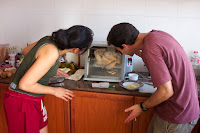
4: … and for pizza amuse bouche.

5: The comfort of spacious apartments, in a city so congested, where so many have so little for themselves….

6: …. and for friends to fill the room and share the table.

7: The chance to learn so much from such talented and generous minds.
(this is a picture from one of the many days of training that Clinton Foundation has facilitated)

8: And, for talented, guitar-playing roommates.

9: The chance to see the sun set over the Atlantic….

10: And, for those reading at home, having seen the sun rise over those same waters.

Happy Thanksgiving Everyone.
The meal capped off a glorious day-and-a-half marathon of cooking and working (mostly emailing while bread baked and turkeys roasted). Preparing for the meal had been most unconventional, but everyone’s efforts (and the good fortune of snagging the last three turkeys that the Grand Prix Grocery store had to offer) resulted in what felt like an evening in the States for one of the greatest holidays.
In fact, our Thanksgiving table was complete with turkeys and gravy, potatoes of all kinds, cornbread stuffing (both veggie, and turkey filled), grilled veggies, cranberry sauce (usually the hardest thing to find over seas) and a slew of desserts.
As we hunkered down for round two, one of my roommates made a valiant efforr to start the “I am thankful for…” game – you know, when everyone goes around the table and lists one thing for which they’re inspired to give thanks.
The table was long, and mouths were full, so the game didn’t make it very far. But, looking through pictures of this night, and the past few months, I felt it appropriate to devote a post to the “I am thankful game.”
Note: Many are Turkey-Day related, some are most random, a few are cliché, and all are sincere
1: I am thankful for a city where many of the cars that pass have steering wheels on the right side of the car… and others are just as likely have them on the left. (Random, I know, but endlessly amusing)
2: I am thankful that IS the bread I baked on Wed night FINALLY dried enough to be used in stuffing the next evening. Note: the air is so humid that it took 36 hours, and to keep the bugs away I dangled the bread, hanging from a colander, from our kitchen (picture below)

3: I am thankful for turkey roasters in Liberia

4: … and for pizza amuse bouche.

5: The comfort of spacious apartments, in a city so congested, where so many have so little for themselves….

6: …. and for friends to fill the room and share the table.

7: The chance to learn so much from such talented and generous minds.
(this is a picture from one of the many days of training that Clinton Foundation has facilitated)

8: And, for talented, guitar-playing roommates.

9: The chance to see the sun set over the Atlantic….

10: And, for those reading at home, having seen the sun rise over those same waters.

Happy Thanksgiving Everyone.
Blue
Taxing home today, I looked out the window to see a bright blue puppy toddle across the road. While I think, at this point, very little in Liberia surprises me, I found this peculiar.
When I inquired of the driver as to the source of these puppy blues, he explained to me that there is a substance called “blue,” is available in most grocery stores, which is used for “shining” fabrics. Many people couple it with laundry detergent or soap to add a sheer finish to their clothing or materials.
Blue also doubles as a flee-repellent – so they say. It’s commonly believed that dousing an animal in the liquid will rid them of the pesky bugs.
I’ve no reason to think one way r the other about how successful an anti-flee treatment this may be – but it seems as good a reason as any to be blue.
When I inquired of the driver as to the source of these puppy blues, he explained to me that there is a substance called “blue,” is available in most grocery stores, which is used for “shining” fabrics. Many people couple it with laundry detergent or soap to add a sheer finish to their clothing or materials.
Blue also doubles as a flee-repellent – so they say. It’s commonly believed that dousing an animal in the liquid will rid them of the pesky bugs.
I’ve no reason to think one way r the other about how successful an anti-flee treatment this may be – but it seems as good a reason as any to be blue.
Sunday, November 11, 2007
On Ice
Walking next to the Barclay Training Center this morning, I saw a young girl approaching at a fast jog. She was holding her arms out and fiercely gripping a boxed shaped object in her palms.
As she got closer, I read her desperate, yet amused, expression and noticed a stream of tears pouring down her face. Completely confused, I couldn't understand what was happening until she passed by and I realized she was running with a block of ice the size of a standard shoe box.
It's about 28 degrees in Monrovia - who knows how far she was carrying this icicle.
As she got closer, I read her desperate, yet amused, expression and noticed a stream of tears pouring down her face. Completely confused, I couldn't understand what was happening until she passed by and I realized she was running with a block of ice the size of a standard shoe box.
It's about 28 degrees in Monrovia - who knows how far she was carrying this icicle.
Subscribe to:
Posts (Atom)

